ERR reporter Mari Peegel reports:
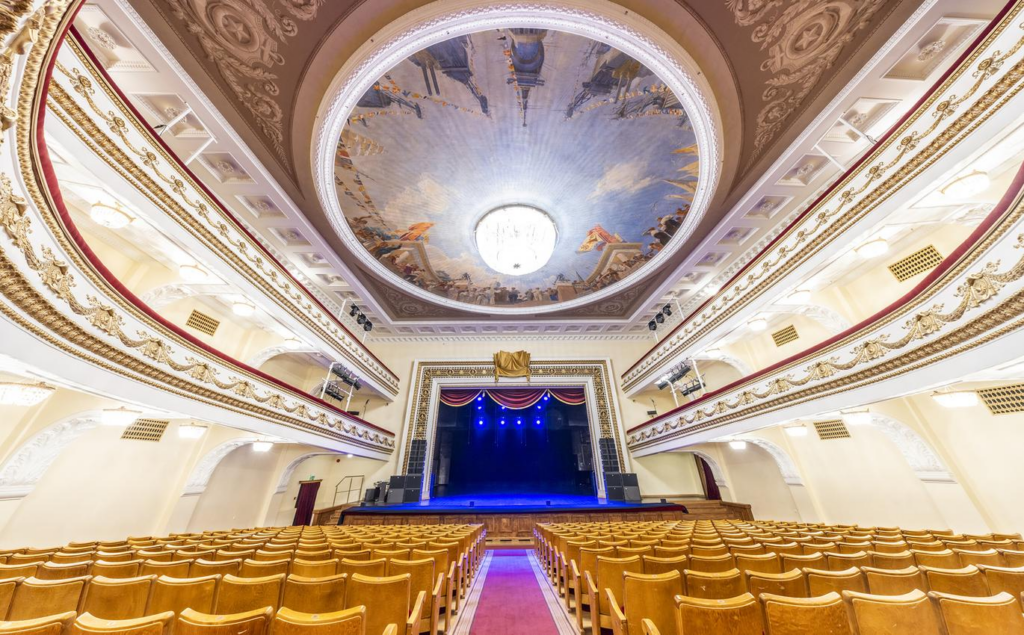
The Tallinn City Foundation Tallinna Kultuurikatel is covering the ceiling mural and Stalinist stucco decorations in the hall of the Mere Cultural Center with fabric. According to the center’s administrator, the hall is ideologically charged, which has prevented the space from being rented out. A reversible solution agreed upon with the heritage protection authorities was deemed acceptable.
According to Kaisa-Liis Kalda, a representative of Tallinn Kultuurikatel—the municipal agency that manages the Mere Cultural Center—permission from the heritage protection authorities to carry out the work was granted in May of this year. Since all of the center’s spaces were in constant use until Midsummer’s Day, it was only possible to close the hall for two weeks of work now, after the end of the season.
Kalda explained that modernizing the spaces and concealing the symbols is essential for fulfilling the center’s objectives.
“It is important to us that the Mere Cultural Center be an open and welcoming place for everyone—for Estonians, for ethnic minorities living in Estonia, including people of Russian descent, as well as for international guests. That is why we want the building’s environment to be as neutral, modern, and unifying as possible. We want the Mere Cultural Center to host an even wider variety of cultural events,” Kalda said.
Kalda added that the permit from the National Heritage Board covers the covering up or removal of various symbols from the hall and their preservation.
“These will remain in their original form beneath the stickers and new ornaments. The decorative coat of arms will be mounted intact on the frame on wheels and preserved. The building’s historical value will be preserved even after these changes are made, and all decisions have been made with the aim of respecting both the architecture and contemporary social values,” said Kalda.
The decision was made at the request of potential tenants
According to Kaarel Truu, a representative of the Heritage Protection Department at the Tallinn City Planning Office, Tallinn Kultuurikatel requested the changes because the controversial appearance of the halls was deterring visitors.
“That mural and the entire interior are still very heavily ideologically charged. For some people, it’s downright unpleasant, and the people at the Mere Center said they couldn’t use that space because tenants and the public refuse to go there,” Truu explained.
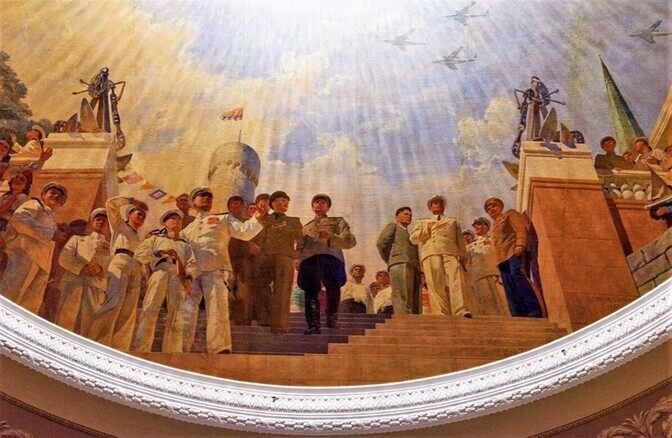
According to Truu, the ceiling painting depicts Soviet soldiers and the navy from an interesting perspective.
“This ceiling painting is a symbol of Soviet imperialism. The people depicted in the painting are all wearing Soviet military uniforms. And there is also Soviet naval symbolism—pentagrams and anchors. The same symbolism can be found around the stage and on the balcony railings,” Truu described.
According to Truu, the artist who created the ceiling painting is unknown.
Truu confirmed that the chosen solution is fully reversible and will not damage the original painting.
“The ceiling will be covered with a material stretched over a frame, which will conceal the artwork. The chandelier should remain in its current location,” he explained regarding the process of concealing the ceiling painting.
The pentagonal stucco decoration surrounding the stage opening and along the balcony railings will also be covered. It will be concealed with plaster elements featuring a neutral motif that blend into the room’s overall composition.
The building continues to tell its story
Although the most conspicuous symbols are concealed, Truu believes the building remains an important example of Stalinist architecture.
“The story of the Cold War and the Soviet occupation can still be told very effectively even after the symbols have been covered up, because there are so many pentagons everywhere in the lobbies and stucco decorations that the entire building is steeped in them. It’s not going anywhere,” said Truu, adding that beneath the Soviet-era layers, the structures of the earlier, so-called “Estonian-era” grand auditorium have also been preserved.
Anita Staub, head of the Architectural Heritage Department at the National Heritage Board, also confirmed that the period-accurate interior remains protected. According to her, the entire building, including the ceiling paintings, remains under heritage protection, but decisions regarding the building as a historic monument are made by the Tallinn City Heritage Protection Department.
“The Heritage Protection Department of the Tallinn City Planning Office handles architectural monuments located in Tallinn based on an administrative agreement concluded with the National Heritage Board. A representative of the National Heritage Board always participates in the decision-making committee, and thus the decision is made in coordination with the Board,” Staub clarified regarding the division of responsibilities.
Although the ceiling mural at the Mere Cultural Center will be covered, Truu emphasized that this does not mean a similar fate awaits, for example, the pentagonal ceiling mural at the Estonia Opera House, the covering of which has also been discussed in recent years.
“The role of the Estonia Hall and the painting in Estonian cultural history is far more significant, and has been discussed and written about at greater length. There has been no talk of anyone wanting to cover it up,” said Truu.
Truu has also not heard of any recommendations to cover up or remove other Stalinist symbols, such as the five-pointed star on the roof of the apartment building located at the intersection of Liivalaia and Tartu Road in Tallinn.
SA Tallinna Kultuurikatel has been managing the Mere Cultural Center building since 2025. Previously, the building was known as the Russian Cultural Center and the Officers’ House. Last April, the City of Tallinn removed the Soviet coat of arms from the cultural center’s facade. The work was based on the coalition agreement and the assessment that the coat of arms was not structurally safe.
Renovation work on the Mere Center’s main hall will take place from July 1 to 14.
Editor: Mari Peegel