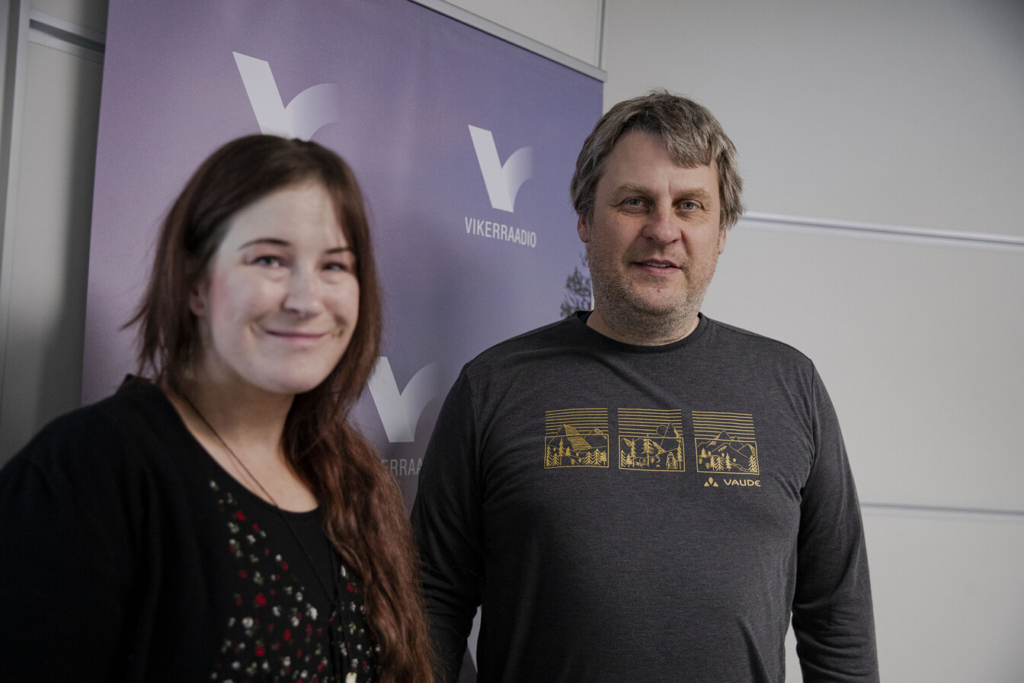
On May 12, 2026, on Vikerraadio’s talk show “Teise mätta otsast,” semiotician Lona Päll and geographer Taavi Pae discussed the changing meanings of landmarks over time.
***
Landmarks that are important to people in their daily lives and sites of national significance often clash in urban planning. At the same time, the meaning of landmarks is constantly changing over time, as semiotician Lona Päll and geographer Taavi Pae discussed on the Vikerraadio program “Teise mätta otsast.”
The example of manor houses illustrates well Estonian society’s current relationship with its historical heritage. Just 70 years ago, such buildings were not valued, and whenever possible, they were dismantled for building materials. Today, Estonian society holds manor architecture in high regard and showcases it to tourists. “It seems to me that there always has to be a generational gap, and then these topics come back. […] At the same time, perhaps our ancestors would think, ‘Look at my grandchildren—they’re still so foolish,’” Pae mused.
Similarly, according to Päll, time must pass before people’s relationship with the legacy of recent history can change. Thus, agreements regarding the future of Tallinn’s Linnahall or the relocation of the red monuments cannot be made hastily. At present, for example, monuments are still too closely associated with people’s personal memories. “There needs to be some distance before we can view this in a more neutral way,” the semiotician agreed.
According to Päll, every generation should have the opportunity to shape public space on its own terms and remove inappropriate symbols from it. For example, a few years ago in the U.S., colonial monuments were taken down from university campuses because the new generation considered it important. However, according to the semiotician, removal is a double-edged sword, because the object being removed may hold meaning for local residents. “It’s as if everyone is rewriting that landscape, but also removing certain signs from it,” he explained.
Who Needs the Moon Store?
In addition to the temporal dimension, people’s expectations often diverge based on who is using the space. Places that are important to local residents often do not overlap with tourist attractions. In everyday life, a local resident navigates by a familiar grocery store or park. “A tourist’s landscape is completely different from that of a local resident. A nature photographer’s landscape is completely different from that of a mail carrier,” Lona Päll noted.
It is precisely these mundane and familiar landmarks that provide the necessary reference points for someone navigating an unfamiliar environment. People sometimes even choose longer routes to pass by a familiar landmark: it helps them orient themselves in space. “For some reason, most people from Tartu who take the train to Tallinn head first to Raekoja plats, even if they need to go somewhere else,” Taavi Pae noted as an example.
Symbols that offer a sense of security usually only attract the attention of the wider public when they are threatened with demolition. The recent closure of the Kuu store in Tartu’s Karlova neighborhood sparked a strong reaction among local residents. “People want this concept to exist—they want us to have small village stores—it’s nostalgic, even though the supporters themselves may not visit the store very often anymore,” Päll noted.
Although shopping habits have changed, local residents have maintained a strong connection to the location. According to Päll, the reactions to the store’s closure point to residents’ desire to preserve the idea of a familiar and safe environment. “We often notice these places, or they come to the forefront when they’re disappearing,” the semiotician added.
Sometimes a familiar image persists even when the physical structure itself has long since been wiped from the landscape. For example, according to Pae, there were thousands of post mills on Saaremaa a hundred years ago, of which only ruins remain today. Nevertheless, the image of the windmill is constantly encountered on local products and in tourism brochures. The geographer remarked: “It’s peculiar how a place no longer physically […] exists, but in our minds it is still very clearly present.”

A Hallmark of a Mature Society
In addition to the demolition of old landmarks, which is threatening to destroy them, entirely new development plans are also sparking major controversies. For example, the Siuru Cultural Center, proposed to replace Tartu’s Central Park, highlights a sharp spatial conflict. For some city residents, the construction means the final destruction of a familiar green space; for others, the completed center would bring Tartu’s cultural community together. “I think Tartu SÜKU has been in the planning stages for quite some time […] clearly also as a landmark,” remarked Taavi Pae.
According to the program’s guests, heated debates over new development plans reflect society’s overall level of development. In the past, large-scale projects were often built while completely disregarding the opinions of local residents. Public debates allow the community’s diverse memories and voices to come to the fore. “The ability to resolve these issues democratically is, after all, a hallmark of a mature society,” the geographer emphasized.
Amid the multitude of vocal opinions, places that aren’t visually appealing tend to fall out of sight. Similarly, in conflicts such as those surrounding Rail Baltic or the construction of a new power line on Saaremaa, the voices of locals whose mushroom forests or recreational areas stand in the way of construction are not heard. Päll noted: “It is precisely contemporary people’s experience of the landscape—even those community forests—that is often not represented in conflict situations.”
According to the guests, decision-makers must strike a balance between grand symbols and personal memories when planning for the future. When the physical environment is destroyed, there is a risk of losing the collective memory embedded within it. The constant transformation of the built environment inevitably leads to ongoing negotiations among various interest groups. “All these conflicts are necessary, because it is precisely through them that different interpretations come to the surface,” said Päll.