
English Translation
August 28, 2026 | ERR Journalist Mari Peegel reports:
The fate of the Väike-Linnape memorial to victims of fascism, removed from Kuressaare a year ago, remains unclear because no party is interested in preserving it or erecting it in a new location. According to both the municipality and military museums, dealing with the monument would be very expensive.
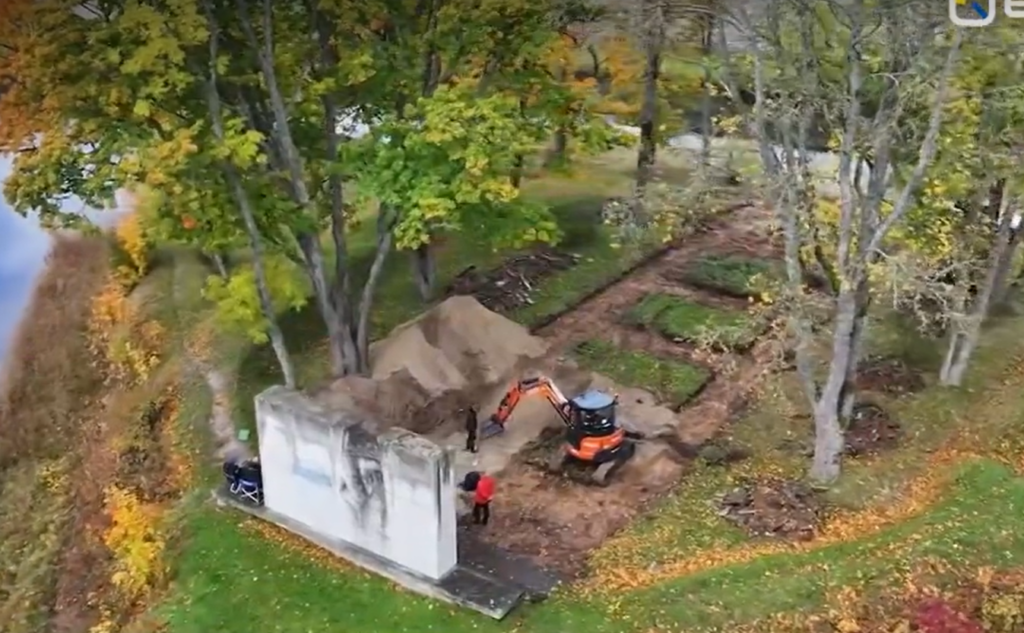
When the dismantling of the monument—erected in 1965 at Väike-Linnape near Kuressaare Castle to honor victims of fascism—and the exhumation of remains began last October, municipal authorities told the public of a plan to relocate the monument to the Sõrve Military Museum, where it would be restored if possible.
Nearly a year later, the Saaremaa municipal government, which has changed leadership in the interim, still does not know what to do with the monument created by architect Allan Murdmaa and sculptors Riho Kulla and Matti Varik. “This question comes as a surprise to me; we haven’t discussed it, and no decision has been made,” said Rural Municipality Mayor Rainer Antsaar. Following a call from ERR, Antsaar noted that a decision might be made next week.
“In about a month—in October—the one-year storage agreement with the municipality expires,” said Peeter Sai, head of the firm Dolokivi, which dismantled the memorial. The disassembled pieces of the monument have been stored in his yard and hangar ever since it was taken down.
“I suppose I have to write to the municipality to ask if they will extend the contract or what will become of the monument. Then we’ll have to decide further. If nobody wants it, the stones will be used as ground fill. If the municipality decides to extend the storage agreement, I will naturally expect payment for it,” Sai stated.
According to Sai, the parts of the monument—dolomite slabs stacked on wooden pallets and a standalone obelisk—have a few minor cosmetic blemishes, but overall, the former monumental sculpture is in good condition.
The problem, Sai explains, is that despite an agreement with the municipality to find a permanent location for the monument within a year, none has been found so far.
“Heritage protection authorities would like to preserve the monument, but erecting it or even just storing it is expensive. To reassemble it, it would have to be refilled with silicate bricks—we broke out the old silicate filling and preserved only the dolomite parts. Moving the monument requires a crane or another hoist. It’s a lot of work that gets costly,” Sai described.
According to Sai, there was talk of the local Sõrve Military Museum taking the monument, but they lack storage space. They already have numerous items, and the 22 to 23 pallets of dolomite and a seven-ton stone block obelisk simply won’t fit there.
Sai added that transporting the monument’s components to Sõrve just for storage makes little sense.
“If no one is going to erect it, there’s no point in hauling it from one place to another. In Sõrve, it would eventually sink into the ground,” Sai said, referring to the monument’s massive weight. The Lagedi Military Museum near Tallinn reportedly also considered taking the monument, but the plan fell through due to high costs.
Sai noted that destroying the monument would naturally be sad. “After all, it is the work of our great masters Murdmaa and Varik. The National Heritage Board will have to come up with something, but right now, the reality is that nobody wants it,” Sai said.
Gunnar Havi, crisis preparedness advisor for Saare Municipality, is slightly more optimistic about the fate of the dismantled monument, though he also admitted that no decision has been made and taking action represents a major financial cost for the municipality.
“There have been different opinions here. It certainly won’t be turned into gravel, but all of this costs money. Fully restoring the monument would cost tens of thousands of euros,” Havi said, adding that they have considered whether to display only the valuable slabs and the obelisk. Havi did not specify where that might take place.

Board: Sad that the Jõgeveste mass grave monument was destroyed
If the Väike-Linnape monument were to be destroyed, it would be the second monument of artistic value to disappear from Estonian art history following a mass grave exhumation. A modernist monument created in Jõgeveste in 1973—also authored by Murdmaa and Varik—was destroyed during a similar process.
From the viewpoint of the National Heritage Board, the protection status of monuments varies, though this does not directly resolve the situation in Kuressaare.
Jüri-Martin Lepp, advisor on art heritage at the National Heritage Board, explained that although heritage protection for the Väike-Linnape mass grave was ended by a 2024 decree—just like in Jõgeveste—the Kuressaare site was subject to additional protection because of its location on the fortifications of Kuressaare Castle, which is a protected heritage site. Therefore, heritage requirements remained in force.
“The marker at the Väike-Linnape mass grave was dismantled and relocated by a certified conservator. All parts of the marker were numbered and stored on Saaremaa, making it possible to exhibit the marker in the future. In the case of the Jõgeveste mass grave marker, the local municipality did not need to inform the National Heritage Board because its status as a protected monument was revoked in 2024,” Lepp explained.
Lepp noted that the monument working group under the Government Office—tasked with determining which markers were worth preserving—had highlighted the high artistic value of the Jõgeveste marker, noting its skillful integration into the surrounding landscape and recommending that its granite slabs and core be preserved in the event of reburial.
“Therefore, it is sad that the marker was largely destroyed during the reburial process. The National Heritage Board is always ready to provide professional advice to preserve works by Estonian artists. For more complex sites, the execution of work must be carefully thought out in advance to avoid damaging cultural heritage, as deliberate planning demonstrates a society’s strength,” Lepp added.
In November of last year, the remains of 199 people executed during the German occupation were reburied from the Väike-Linnape mass grave. Unlike most other World War II-era mass graves reburied in Estonia, these remains belonged to Estonian civilians rather than military personnel. The executions of these civilians were carried out in the Loode oak grove and Mändjala.
The Loode oak grove was also the site of the first memorial erected by Soviet authorities in their memory. In the 1960s, the mass grave was relocated to the ravelin of Kuressaare Castle at Väike-Linnape, where a modernist monument was commissioned. In addition to the names of the victims, it bore the carved inscription: “Living ones, remember!”
Editor: Mari Peegel