ERR reporter Maria-Ann Rohemäe reports on the decision reached between the Mere Cultural Center and the National Heritage Board.
***
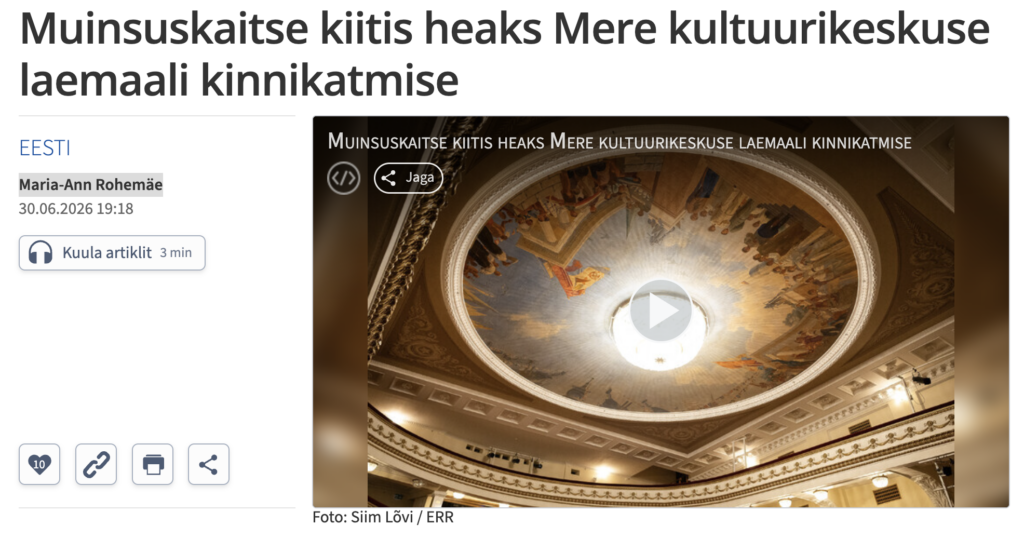
The ceiling painting and Stalinist stucco decorations in the hall of the Mere Cultural Center will be covered up during renovation work. The coat of arms featuring a hammer and sickle will also be removed from the stage. According to the center’s management, the hall is too ideologically charged, which is why many people are reluctant to visit the building or rent its spaces. The solution found by the heritage preservation authorities was acceptable.
Over the next couple of weeks, the ceiling painting at the Mere Cultural Center will be covered as part of the renovation work.
“The simplest solution was to install a ceiling grid here, which will hang a few centimeters lower than the ceiling and will not damage the painting in the slightest, since none of the mounting points will be attached to the painting itself. It gives exactly the impression that it is simply a regular white ceiling,” said Kert Talistu, director of the Mere Cultural Center.
The artist behind the ceiling painting glorifying the Soviet military is unknown, but it was modeled after classic ideological art. For example, the ceiling paintings in Jesuit churches from the Baroque era, which also used a bottom-up perspective.
“In religious art of that time, this was meant to convey how people strive toward eternal values, and the church serves as a kind of inevitable mediator that guarantees our passage into eternity; whereas here, this religious otherworldliness is replaced by the ideal of a socialist—or later, even communist—society,” said architectural historian Oliver Orro.
The bows of warships are visible from the deck, creating the sensation that the viewer is underwater. Orro considers this a unique approach. He adds that the creators of the entire building were artists and architects with an academic background from St. Petersburg, who mastered their craft well in terms of formal expression. For this reason, the covering up or removal of some of the symbolism evokes mixed feelings in Orro.
“This building was designed in its time with great thoughtfulness, at a very high artistic level, but of course also steeped in ideology. And in a sense, this building was also meant to justify to the Soviet military personnel stationed in Estonia—among whom there were undoubtedly intelligent and thoughtful people—why they were here,” said Orro.
According to Orro, the building was meant to portray the Soviet occupation as natural and certainly represents Stalinism in its most horrific form. Many people find it difficult to look at.
“This needs to be done today so that the building can be more open to all other visitors—Estonians, Russians, of course, and members of minority groups. Today, however, it has met with such a negative reaction that many people do not want to come; they feel a bit of apprehension and fear,” said Talistu.
In addition to the ceiling mural, the pentagons on the first balcony and at the corners of the stage will also be covered. The coat of arms featuring a hammer and sickle will also be removed from the stage. It will be placed in the museum being established at the Mere Cultural Center.
Editor: Johanna Alvin
Source: “Aktuaalne kaamera”