On December 10, 2026, a mini-symposium on the topic of preserving Soviet-era public art will be held in Vilnius, initiated by the Lithuanian Design Foundation. The speakers will be glass artist and associate professor at the Vilnius Academy of Arts Žydrūnas Mirinavičius, and Gregor Taul, a collaborator of the How to Reframe Monuments project.
Event on Facebook: https://www.facebook.com/events/4135471220041635/
***
14:00 Dr. Gregor Taul (EKA – Estonian Academy of Arts) lecture Inferior interiors? The afterlives of Soviet-era monumental paintings
14:45 Presentation by Žydrūnas Mirinavičius on the stained glass and glass art of female artists of the 1960s in Lithuania – Marija Anortė Mackelaitė, Filomena Ušinskaitė, and Gita Laimutė Baginskienė.
15:30 Discussion with the speakers, architect Mantas Peteraitis, and curator Monika Lipšic.
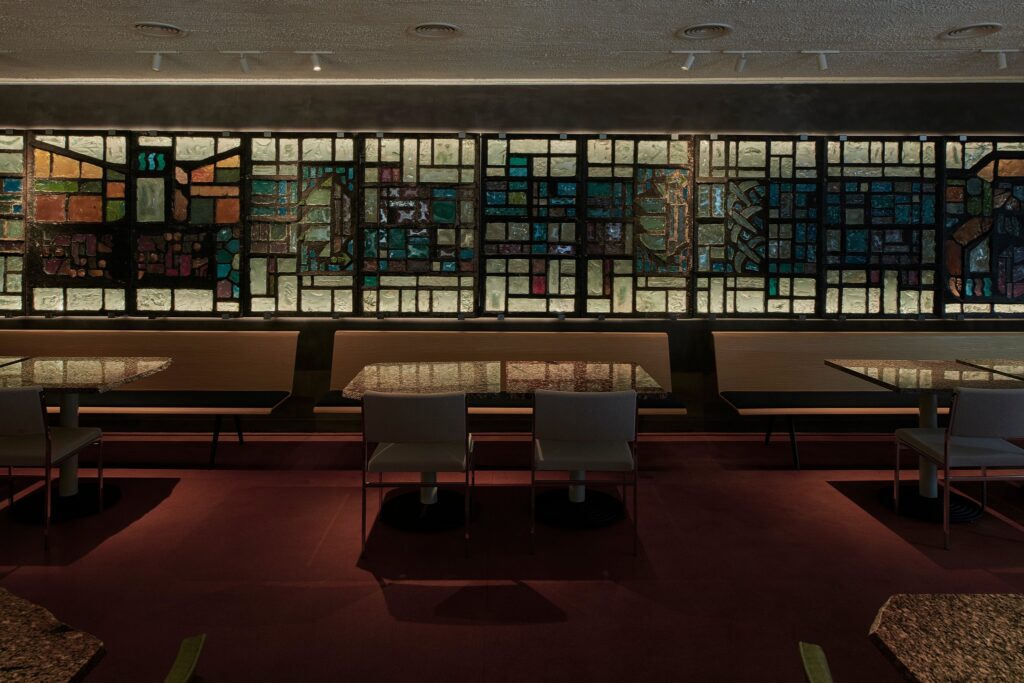
While designing the restaurant Tummo, interior architect Mantas Peteraitis integrated a preserved stained-glass work by Marija Anortė Mackelaitė (b. 1930), which he rescued from a demolished building in Klaipėda. This story once again prompted a search for ways to highlight the preservation of heritage from the 1960s–1980s and to explore new methods for doing so. Since the 1960s, Lithuanian stained glass has undeniably become a platform for experimental creativity: from thick-glass, abstract-leaning compositions to kinetic installations integrating sound. Perhaps the integration of monumental artworks into contemporary architectural projects could serve as one of the methods of experimental preservation?
Attention to large-scale works from the Soviet period (then referred to as monumental-decorative art), especially to its decorative branch, where various technological and artistic innovations often appeared, broadens cultural memory and allows the surviving artifacts to be interpreted creatively and contemporarily. And very few of them remain.
During the event, Žydrūnas Mirinavičius, lecturer at the VAA Department of Site specific art and Scenography will present the works of three women artists who created stained glass in the 1960s. Alongside Marija Anortė Mackelaitė, he will discuss the work of Filomena Ušinskaitė, whose stained-glass pieces once decorated the Kaunas children’s café Pasaka, as well as the work and artistic legacy of Laimutė Baginskienė.
Estonian researcher, art historian, and semiotician Dr. Gregor Taul from the Estonian Academy of Arts will present a talk titled ‘Inferior interiors? The afterlives of Soviet-era monumental paintings.’ More about the lecture:
During the Soviet period, hundreds of site-specific monumental artworks were created for public buildings in the three Baltic countries. Although only a few of the original murals, mosaics, stained-glass works, ceramic pieces, or textile compositions contained ideological messages, after the collapse of the Soviet Union many were destroyed as worthless artifacts of a past era. Nevertheless, many works have survived, and some were exceptionally conserved or found an “afterlife” in public space in another form. One such example is the recontextualisation of the mural by Algirdas Steponavičius and Birutė Žilytė in the MO Museum bistro. Another more recent example is the recontextualisation of Anortė Mackelaitė’s stained glass in the Vilnius restaurant Tummo, notes Gregor Taul. In his presentation, he will discuss examples from Estonia, Latvia, and Lithuania showing how Soviet-era monumental-decorative artworks have been repurposed in recent years, and consider whether such recontextualisation diminishes or enhances their value. What happens to transformed interior spaces—do they become inferior or superior?
The event will also feature architect Mantas Peteraitis and curator Monika Lipšic.
The project is supported by the Lithuanian Council for Culture.